Key takeaways
Never use dog flea products on cats.
Use only cat-labeled products, dosed by feline weight.
Treat both the cat and the home.
Deworm if fleas are present.
Stay on schedule for at least 3 months.
Many dog flea products contain permethrin — safe for dogs, extremely toxic to cats. A single drop can cause tremors, seizures, and fatal collapse. Never split a dog dose. Confirm the label says FOR CATS with a feline weight range.
Essential-oil sprays such as tea tree, peppermint, and citrus can cause liver and neurological damage in cats. Do not use them as flea treatment unless a veterinarian specifically approves them.
Never split one tube between two cats. Underdosing fails; overdosing cats — especially kittens and seniors — is a real toxicity risk.
| Format | Actives | Speed | Duration | Best For |
|---|---|---|---|---|
| Topical spot-on | Fluralaner, fipronil | 8–12 h | Up to 12 weeks | Indoor cats, prevention, tick cover |
| Oral chewable | Fluralaner | Within hours | Up to 12 weeks | Cats that swim or get bathed; heavy outbreaks |
| Topical spray | Fipronil | Immediate | Up to 4 weeks | Kittens, heavy infestations, multi-cat homes |
| Worming tablet | Milbemycin oxime + praziquantel | 24–48 h | Repeat monthly | Flea-borne tapeworm, roundworm, hookworm |
Comb your cat’s tail base, neck, and belly. Wipe any dark specks onto a damp white paper towel:
Dissolves into a reddish-brown smear → flea dirt, or digested blood. Your cat has fleas.
Stays dark and grainy → probably just dirt.
Also look for red bumps, scabbing, and hair loss along the lower back — signs of flea-bite dermatitis.
For indoor cats and set-and-forget protection, plus tick cover. One application lasts up to 12 weeks, versus the 30 days older spot-ons deliver. For cats 8 weeks and 1.2 kg+, apply to skin, not fur.
For kittens, heavy active infestations, multi-cat households, or cats that reject spot-ons. It also lets you treat environmental hotspots like bedding and cat trees.
For cats that swim or are bathed often, long-haired cats, or homes with dogs that groom them. Chewables cannot be licked or washed off and leave no residue on the coat.
For any cat with fleas that has not been dewormed this month, or if you have seen rice-like segments near the tail base or in bedding.
The tapeworm Dipylidium caninum uses the flea as its intermediate host. Cats get it by swallowing an infected flea while grooming.
Kill fleas but skip deworming → your cat may still carry tapeworms.
Treat tapeworms but leave fleas → reinfection within weeks.
Flea control and deworming are two halves of one job. A milbemycin oxime + praziquantel tablet covers the internal side while your flea product handles the vector. Feline milbemycin/praziquantel often starts at 6 weeks and 0.5 kg, repeated monthly — always follow your local label and veterinarian advice.
Spot-ons: Part the fur at the base of the skull, between the shoulder blades — the one spot a cat cannot reach. Put the tip on skin, not topcoat. Keep pets and children away until the fur is dry. No bathing for 48 hours before or after. Never split one tube between two cats.
Chewables: Offer with food or by hand. If it is spit out, do not double-dose — ask your vet.
Sprays: Work in a ventilated room, protect the eyes and muzzle, spray against the coat grain, then massage in. For kittens, apply to a soft brush rather than bare hands.
Weight bands are not suggestions. Follow them exactly.
Adult fleas on your cat are only about 5% of the infestation. The other 95% are eggs, larvae, and pupae in carpets, cushions, and bedding.
Vacuum daily for two weeks — carpets, baseboards, under furniture, and the car. Empty the canister outside immediately.
Wash all cat bedding weekly in hot water.
Steam-clean carpets if the infestation is heavy.
Spray hard-to-wash items such as cat trees and carriers with fipronil and let them dry fully.
Keep every pet on the same schedule.
Flea pupae survive for months and resist most insecticides. That is why the first round can look like it “failed.” Stay on schedule for three consecutive months.
Yes. Fleas ride in on clothes, shoes, and pant legs, hitch a ride on household dogs, and migrate through shared walls and balconies.
They can be safe only when you use a cat-labeled product, follow the weight range, and apply it exactly as directed. Never use dog products. Ask a vet first for kittens, pregnant cats, seniors, or cats with health conditions.
Wait at least 48 hours before and after application unless the product label says otherwise. Bathing too soon can reduce effectiveness.
You may be seeing newly emerged fleas from pupae in the environment. Continue vacuuming, treat all pets, and repeat according to the label. If the infestation persists or your cat worsens, contact your vet.
No. Many dog products contain permethrin, which is highly toxic to cats. Never split a dog dose or use a dog product “just in case.”
Not automatically. Tea tree, peppermint, citrus, and many essential oils can be toxic to cats. Do not apply them without veterinary guidance.
Yes, if your cat has fleas and has not been dewormed this month. Fleas can carry tapeworm larvae. Use a cat-safe dewormer and follow the label.
Call immediately if you see tremors, seizures, collapse, vomiting, lethargy, or difficulty breathing after flea treatment. Also call a vet for kittens, pregnant cats, sick cats, or if fleas persist after 3 months of correct treatment.
Feline antiparasitics demand precise active blending, validated safety margins, and market-by-market regulatory compliance.
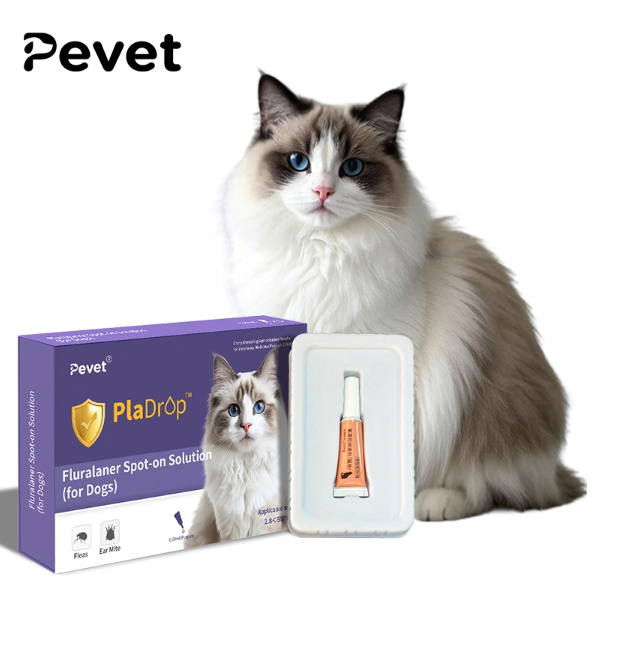
Pevet manufactures a full feline range: Fluralaner Spot-On Drops, Fipronil Spray, Fluralaner Chewable Tablets, and Milbemycin Oxime + Praziquantel Tablets. As an OEM/ODM pet pharmaceutical manufacturer, we help private-label brands launch safe, compliant OTC antiparasitics — from formulation and dosing through labeling and export documentation.
Pet parents: ask your retailer for Pevet.
Brands & distributors: talk to us about private-label development.
Medical disclaimer: This article is for educational purposes only. Always read product labels and consult a veterinarian before treating your cat, especially if it is young, pregnant, senior, or unwell.


